Space & time · A tiny calculator worth trying
Your birthday means something wildly different on Mars.
Enter your numbers and tap the button to see the result.
Understand your result
How old would you be on another planet?
Short answer: You have lived the same amount of time everywhere, but a year is a different length on each planet. Mercury circles the Sun quickly, so you would count more Mercury years. Neptune moves slowly, so you would count far fewer Neptune years.
What the calculator is measuring
Earth’s year is the time it takes our planet to go around the Sun once. Another planet’s year is the time that planet needs for one orbit. Your age on Mars is not your age in Mars days, and it is not the age you would feel if you traveled there. It is simply how many Martian orbits fit into the time since your birth.
Our calculator starts with your birthday, finds the whole Earth days that have passed, and uses approximate orbital periods. The ratio for Earth itself is very close to one. A rough mental shortcut is Earth age ÷ the planet’s orbital period in Earth years. Results can vary slightly from a shortcut because the live calculator works from your actual birthday and elapsed days.
Planet-year comparison
Here is a simple reference using the approximate year ratios in the installed calculator. The example column asks what 20 Earth orbital years would be when counted in each world’s years. These are illustrative values, not an exact birthday-based result.
| Planet | 1 local year (Earth years) | 20 Earth years becomes |
|---|---|---|
| Mercury | 0.241 | 83.04 years |
| Venus | 0.615 | 32.51 years |
| Earth | 1.000 | 20.00 years |
| Mars | 1.881 | 10.63 years |
| Jupiter | 11.863 | 1.69 years |
| Saturn | 29.447 | 0.68 years |
| Uranus | 84.017 | 0.24 years |
| Neptune | 164.791 | 0.12 years |
Why do the numbers vary so much?
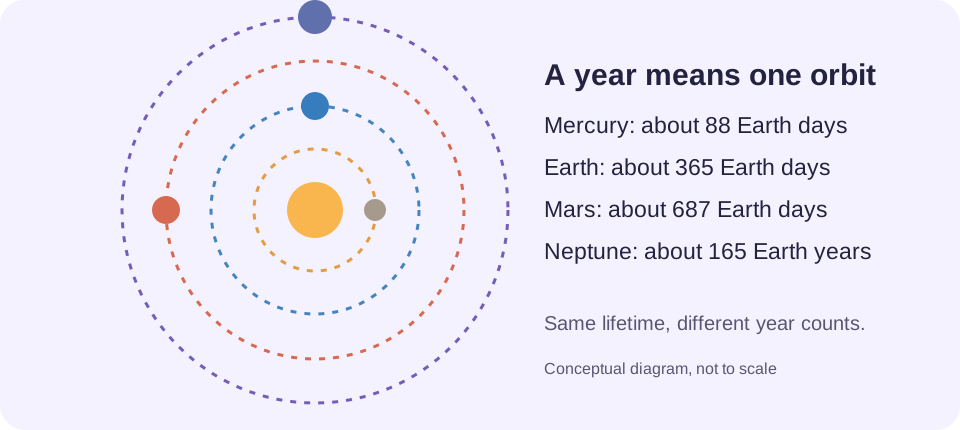
Planets nearer the Sun generally complete an orbit faster than planets far away. Mercury needs only about 88 Earth days for a trip around the Sun. Neptune takes about 165 Earth years. You do not need to leave Earth to compare those calendars: the calculator converts your elapsed time into each planet’s orbital-year unit.
One caution: a planet’s day and its year are not the same. A day is associated with rotation; a year with revolution around the Sun. Venus, for example, has an unusual slow and backward rotation, but that does not change the definition of its orbital year.
Try it as a science activity
- Enter your real birth date and choose Mars. Record your estimated Mars age.
- Change only the planet to Mercury. Explain why your number rises.
- Choose Neptune. What fraction of one Neptune year have you lived?
- Ask which result changes your actual lifetime. The answer is: none of them.
Frequently asked questions
Would my birthday happen more often on Mercury?
You would finish more Mercury orbital years in the same amount of elapsed time. A real birthday celebration depends on which calendar you decide to use; the calculator does not create a permanent off-world calendar.
Can I use this for a baby or someone over 100?
Yes, within the birthday range the form permits. Very short lifetimes can be a small fraction of a distant planet’s year. Future birthdays and invalid dates are rejected.
Does the result use leap years?
The calculator counts the calendar days elapsed since the entered birthday rather than assuming every Earth year has exactly 365 days. It then converts that elapsed time using an approximate orbital-period reference.
Further reading: NASA Planetary Fact Sheet and NASA’s explanation of orbital periods. Our displayed values follow the calculator’s fixed comparison constants and may differ slightly from rounded tables.