Space & gravity · A tiny calculator worth trying
Compare Earth pounds with the pull of another world.
Enter your numbers and tap the button to see the result.
Understand your result
Why would you weigh something different on Mars or Jupiter?
Short answer: Your mass stays the same, but the force pulling on that mass depends on gravity. The calculator takes the number on your Earth scale and estimates the scale reading you would get using a selected planet’s reference gravity.
Mass and weight are not the same
Mass describes the amount of matter in an object. Weight is a force due to gravity. In daily life we often use pounds or kilograms when talking about either one, but the distinction matters in space. Imagine carrying the same backpack from Earth to Mars. The backpack’s contents do not disappear, yet the downward gravitational force is weaker on Mars.
Keep the unit consistent: a person entering 150 pounds receives a pounds-style comparison; someone entering 68 kilograms receives a kilograms-style scale reading. Neither changes their mass. The example figures below follow the exact gravity constants used by our current calculator, not a claim about what an actual bathroom scale would do in every environment.
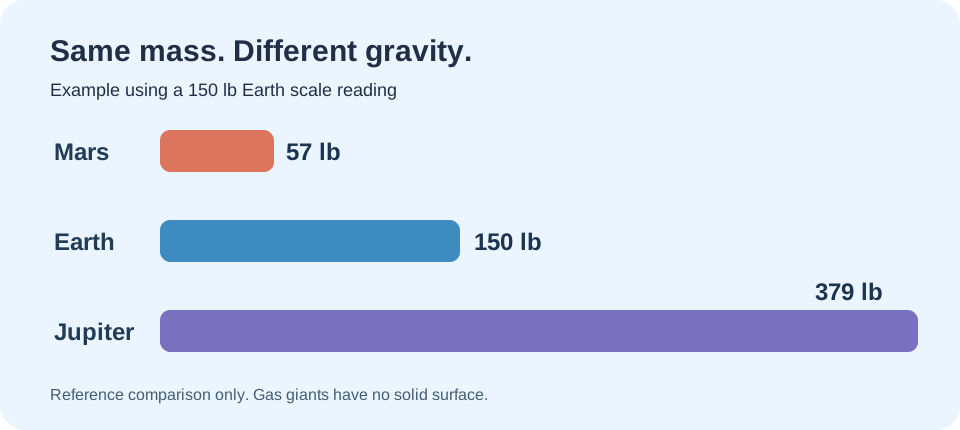
What would a 150-pound Earth scale reading look like?
| Planet | Reference gravity (m/s²) | Estimated reading |
|---|---|---|
| Mercury | 3.70 | 56.6 lb |
| Venus | 8.87 | 135.7 lb |
| Earth | 9.80665 | 150.0 lb |
| Mars | 3.71 | 56.7 lb |
| Jupiter | 24.79 | 379.2 lb |
| Saturn | 10.40 | 159.1 lb |
| Uranus | 8.87 | 135.7 lb |
| Neptune | 11.15 | 170.5 lb |
Important limitation: you cannot stand on every planet
Mars has a rocky surface. Jupiter, Saturn, Uranus and Neptune do not have a solid surface like Earth’s ground. Scientists quote gas-giant gravity at specified atmospheric reference levels, and different fact sheets may use different definitions of radius, latitude and rotational effects. For example, NASA’s general comparison sheet may give a different rounded Jupiter gravity value from this calculator’s 24.79 m/s² reference. This is a physics illustration, not a travel prediction or a claim you could weigh yourself on Jupiter.
Try it yourself
- Enter 150 pounds and select Earth. You should get about 150.
- Keep the input exactly the same and select Mars. The displayed number should be much lower.
- Try Jupiter. The number is much higher because the chosen reference gravity is greater.
- Switch your input unit to kilograms and use a kilogram value. Notice that the underlying gravity ratio is unchanged.
Frequently asked questions
Would I actually lose mass on the Moon or Mars?
No. A gravity change alone affects weight, not mass. The Moon is not included in this particular eight-planet selector.
Why is Saturn’s number close to Earth’s?
Even though Saturn is enormous, its reference gravity is relatively close to Earth’s. Planet size alone does not tell the whole story: mass distribution and distance from a planet’s center both matter.
Is this a health or body-weight calculator?
No. It does not predict changes in body composition. It compares gravitational forces using the scale reading you supply.
Further reading: NASA Planetary Fact Sheet, NASA’s reference-gravity definitions, and NASA Jupiter facts.